
vacation rental management services
What Vacation Rental Management Services Should Include
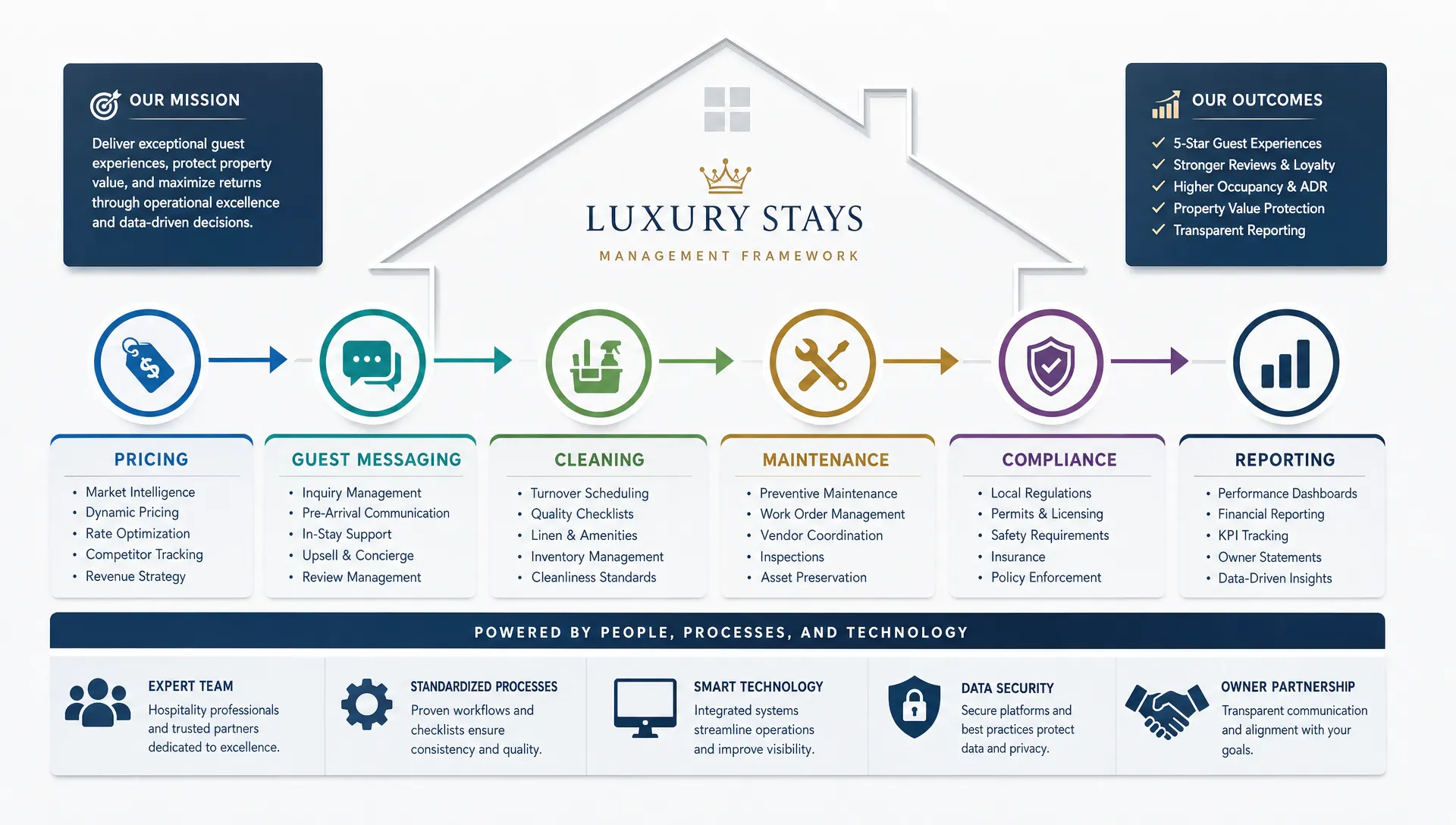
Vacation rental management services should include far more than listing your home and answering guest messages. For a luxury property, your manager should own the full operating system: positioning, pricing, distribution, guest communication, housekeeping, maintenance, compliance, owner reporting, and asset protection. If a company cannot explain exactly how those pieces work, you are not comparing full-service management. You are comparing a co-host with better branding.
A simple definition: full-service vacation rental management means one accountable operator handles the rental strategy and daily execution so the owner is not managing guests, cleaners, vendors, calendars, pricing, or problems.
For luxury homes, that definition needs to go one level deeper. The right manager should protect the property as an asset, not just keep the calendar full.
What vacation rental management services should include
The service package should be specific enough that you know who handles each task, how decisions are made, what gets reported, and what happens when something goes wrong.
Here is the baseline I would expect before trusting a luxury home to any operator:
| Service area | Basic management | Full-service management | Luxury-grade management |
|---|---|---|---|
| Listing setup | Photos and platform listing | Positioning, copy, pricing, multi-platform launch | Brand-level merchandising, guest persona strategy, amenity packaging |
| Pricing | Static nightly rates | Dynamic pricing and calendar strategy | Revenue management tied to seasonality, events, fees, length of stay, and margin |
| Guest messaging | Replies during business hours | 24/7 guest support | Fast response, proactive check-in guidance, experience curation, issue prevention |
| Cleaning | Schedules cleaners | Coordinates turnovers and restocking | Inspection standards, linen control, damage checks, luxury presentation |
| Maintenance | Calls vendors when needed | Dispatches repairs | Preventive maintenance, vendor accountability, owner escalation rules |
| Compliance | Basic reminders | Licensing and tax support process | Market-specific risk review and documentation discipline |
| Reporting | Monthly payout | Revenue and occupancy reporting | Clear owner visibility into income, expenses, issues, and asset performance |
At Lumina, we manage this like an operating company, not a passive listing service. Our homes are private, entire-home stays, so the guest expectation is higher than a generic apartment rental. That affects everything from the pre-arrival message to the way outdoor cushions are staged after a storm.
What does full-service vacation rental management mean?
Full-service management means the owner is not the backstop for daily operations. If the Wi-Fi drops, a cleaner calls out, a guest asks for early check-in, or pool heat needs to be adjusted, the manager should have a process before the owner hears about it.
That does not mean owners should be kept in the dark. It means owners should be involved at the right level: strategy, approvals, performance, and asset decisions. They should not be texting plumbers while sitting in a dinner meeting.
If you want a deeper breakdown of the owner experience, we covered the hands-off model in our guide to vacation rental property management for hands-off owners.
1. Market positioning before the listing goes live
A strong manager should start before the listing is published. Most underperforming rentals are not failing because the home is bad. They are failing because the market positioning is lazy.
Generic positioning sounds like this: “Beautiful home near everything.” That tells the guest nothing. A better operator identifies who the property is really for and builds the offer around that buyer.
For example, a five-bedroom Scottsdale home with a private pool is not just “spacious.” It may be a family gathering property, a golf weekend base, a corporate retreat house, or a couples’ getaway with resort-style outdoor space. Each angle changes the photography, headline, amenities, house rules, pricing, and minimum stay strategy.
Your manager should handle:
- Competitive set review by property type, not just bedroom count
- Professional photography direction and shot list
- Listing copy that sells the actual guest experience
- Amenity positioning for pools, hot tubs, EV chargers, workspaces, views, kitchens, and outdoor areas
- Launch calendar strategy for the first 30 to 90 days
- House rule creation that protects the home without scaring off good guests
This is where luxury management separates itself from commodity hosting. Anyone can upload photos. A serious operator knows which photo should lead, which amenities should be monetized, and which guest type will respect the property.
2. Revenue management, not just nightly pricing
A vacation rental manager should not set rates once and hope the algorithm handles the rest. Revenue management includes nightly rate, minimum stays, length-of-stay discounts, event compression, seasonality, booking windows, cancellation policy, add-on revenue, and cost control.
The most expensive mistake I see owners make is focusing on gross nightly rate while ignoring net income. A home can look successful on the calendar and still leave too much money on the table if cleaning costs, pool heat, utilities, maintenance, discounts, and platform fees are not managed carefully.
We learned this early in Scottsdale. Pool heat can be a guest-loved amenity and a margin problem if it is treated casually. In winter, heating a large pool is not a small operational detail. We now price and communicate it deliberately, because luxury guests appreciate clarity and owners deserve to preserve margin.
A good manager should review these pricing inputs consistently:
| Pricing input | Why it matters |
|---|---|
| Seasonality | Luxury demand can swing sharply by market, weather, holidays, and school calendars |
| Local events | Conferences, festivals, sporting events, and peak weekends can support premium pricing |
| Booking window | A last-minute gap needs a different strategy than a prime week six months out |
| Minimum stays | The wrong minimum stay can block better bookings or create awkward calendar gaps |
| Amenity costs | Pool heat, hot tubs, EV charging, and premium utilities need margin awareness |
| Guest quality | Higher revenue is not worth a booking that puts the asset at risk |
Soft CTA: If you are trying to decide whether a management fee can make sense financially, our article on when vacation rental management pays off walks through the owner-side math in more detail.

3. Guest communication from booking to checkout
Guest communication is one of the clearest ways to tell whether a manager is truly operational or just administrative.
The standard should not be “we answer messages.” The standard should be: guests receive the right information before they need it, and when they do ask a question, the answer comes fast enough to prevent frustration.
At Lumina, our operations are built around AI-powered guest service with 24/7 instant response and an under 10-minute average reply time. That matters because guests do not care that it is 11:30 p.m. when they cannot find the thermostat setting. They care whether someone helps them.
Vacation rental management services should include:
- Pre-arrival instructions that reduce confusion
- Keyless access setup and troubleshooting
- Early check-in and late checkout coordination when available
- House manual guidance that is clear and accurate
- Local recommendations when guests want a curated stay
- Fast escalation for urgent maintenance issues
- Checkout reminders that protect the home and support smooth turnovers
One owner we worked with was hesitant about smart locks because he worried guests would find them impersonal. The opposite happened. Guests liked not waiting for a key handoff, and the owner liked that access could be monitored and changed without sending a human to the property. In luxury rentals, convenience often feels more personal than forced face-to-face coordination.
4. Cleaning, inspections, and maintenance coordination
Cleaning is not a commodity service in a luxury rental. It is part of the guest experience and part of asset protection.
A guest may forgive a small design quirk. They will not forgive hair in a shower, a stained pillowcase, a sticky kitchen drawer, or a hot tub that looks questionable. Luxury guests notice details because they are paying to avoid friction.
Your manager should have a documented turnover standard, not just a cleaner’s phone number. That standard should include linens, towels, kitchen inventory, outdoor spaces, trash, grill condition, pool and spa readiness, remote controls, light bulbs, HVAC settings, and damage checks.
Maintenance should also be proactive. Waiting for guests to report problems is not a plan. It is a review risk.
A serious manager should coordinate:
- Regular property inspections
- Preventive maintenance schedules
- Vendor dispatch and follow-up
- Emergency repair escalation
- Post-stay damage review
- Inventory and restocking
- Owner approval thresholds for larger repairs
For luxury homes, the manager should know the property well enough to spot what is “off.” A cleaner may see that a patio chair is crooked. An operator should ask why it moved, whether wind damaged it, and whether the next guest will notice.
5. Compliance, taxes, insurance, and risk management
Vacation rental management services should include a clear compliance process. That does not mean your manager replaces your attorney, CPA, or insurance advisor. It means they should understand the operational requirements of the market and help you avoid obvious mistakes.
Depending on the property, compliance can involve business licenses, short-term rental permits, occupancy limits, noise rules, parking restrictions, lodging taxes, HOA rules, safety equipment, pool signage, data privacy, and insurance coverage.
For owners with properties in multiple jurisdictions, legal structure and compliance can get complicated quickly. If your portfolio involves international ownership, local licensing, or cross-border risk questions, it is worth speaking with qualified counsel, such as Henlin Gibson Henlin for Jamaica-related compliance and risk law, rather than relying on a vacation rental operator to give legal advice outside their lane.
Here is what I would ask any manager:
| Compliance question | What you are looking for |
|---|---|
| Who tracks local rule changes? | A defined person or process, not “we keep an eye on it” |
| Who files taxes and reports revenue? | Clear division between manager, owner, and CPA |
| Are guest limits enforced? | House rules, screening, and monitoring process |
| Are smart devices disclosed properly? | Transparent guest-facing language and privacy awareness |
| What insurance do you require? | Alignment between rental activity and property coverage |
In markets like Manhattan Beach, Laguna Beach, Scottsdale, and San Juan, local rules and neighborhood expectations can shape the operating model. A manager who treats every market the same is creating risk.

6. Owner reporting and financial transparency
Owners should not have to chase their manager to understand performance. Reporting should show more than “you earned this much.” It should help you understand how the asset is performing.
At minimum, owner reporting should include revenue, occupancy, average nightly rate, fees, reimbursable expenses, maintenance costs, and upcoming reservations. For higher-end homes, I also want to see notes on guest patterns, recurring operational issues, amenity performance, and improvement recommendations.
This is where some management companies get uncomfortable. They prefer owners to look only at gross revenue because it sounds impressive. I prefer net clarity. If we recommend a new amenity, a design refresh, or a pricing change, the owner should understand why.
If you are interviewing several operators, compare their reporting and decision-making process, not just their fee. Our guide on how to compare vacation rental management companies covers the questions I would ask before signing.
What vacation rental management services are usually not included?
This is where owners need to read carefully. “Full-service” does not always mean “everything is included in the management fee.” Some items may be pass-through costs, optional upgrades, or owner-paid expenses.
That is not a problem if the agreement is transparent. It is a problem when owners find out after the first statement.
| Item | Should the manager handle it? | Is it always included in the fee? |
|---|---|---|
| Professional photography | Usually yes | Sometimes included, sometimes billed separately |
| Deep cleaning | Yes | Often separate from standard turnover cleaning |
| Maintenance labor and parts | Coordinate yes | Usually owner-paid |
| Linen replacement | Yes | Usually owner-paid or reserve-funded |
| Permit applications | Support yes | Government fees are usually owner-paid |
| Major design upgrades | Advise or coordinate | Usually owner-paid |
| Smart home devices | Install or manage when part of service | Varies by manager and property |
| Insurance | Require and review basics | Owner-paid |
The key is not whether every cost is bundled. The key is whether the manager can explain the operating model clearly before you sign.
How to choose vacation rental management services without getting a thin package
The easiest way to avoid a bad fit is to ask operational questions. Sales decks can look polished. Operations reveal the truth.
Ask these questions before signing:
- Who answers guest messages after 10 p.m.?
- What is your average response time?
- How do you inspect after every stay?
- Who approves maintenance work, and at what dollar threshold?
- How do you set rates during peak season and shoulder season?
- What happens if a cleaner cancels the morning of check-in?
- How do you handle guest complaints before they become bad reviews?
- What reports will I receive each month?
- What costs are not included in the management fee?
- How do you protect the home from parties, misuse, and avoidable wear?
Then listen for specificity. A good operator will answer with process. A weak operator will answer with reassurance.
Red flags in a vacation rental management agreement
Some warning signs show up before the first booking. Pay attention to vague scope, unclear fees, and promises that sound too easy.
I would be cautious if a manager:
- Talks only about occupancy, not net owner income
- Cannot explain who handles after-hours guest issues
- Uses the same listing strategy for every property
- Has no written cleaning or inspection standards
- Pushes discounts without explaining margin impact
- Avoids questions about maintenance approvals
- Cannot describe local compliance responsibilities
- Sends reports that do not show expenses clearly
- Treats luxury guests the same as budget travelers
The biggest red flag is operational vagueness. If the company cannot tell you exactly what happens when something goes wrong, the owner will probably become the backup plan.
Is full-service management worth it for a luxury home?
Full-service management is worth it when the manager increases net income, protects the property, improves guest experience, and removes meaningful time burden from the owner. It is not worth it if the company simply takes a percentage while the owner still solves the hard problems.
Here is the honest trade-off:
| Option | Pros | Cons | Best fit |
|---|---|---|---|
| Self-management | Maximum control and no management fee | Time-intensive, operationally stressful, easy to underprice | Owners who live nearby and enjoy hosting |
| Co-host or partial support | Lower cost and some help | Owner may still manage vendors, strategy, and escalations | Smaller properties or experienced hosts |
| Full-service management | Hands-off ownership, professional operations, stronger guest consistency | Management fee and less day-to-day control | Luxury owners, investors, second-home owners, busy professionals |
For high-end properties, the question is rarely “Can I do this myself?” Many owners can. The better question is “Is this the best use of my time, and am I operating at the level the property deserves?”
Frequently Asked Questions
What should vacation rental management services include? They should include listing strategy, pricing, guest communication, check-in support, cleaning coordination, inspections, maintenance dispatch, compliance support, owner reporting, and revenue management. For luxury homes, they should also include asset protection, amenity strategy, and a higher standard of guest service.
Do vacation rental managers handle cleaning and maintenance? A full-service manager should coordinate both. Standard turnovers, inspections, vendor scheduling, emergency repairs, restocking, and owner approval rules should be clearly defined before the property goes live.
How much do vacation rental management services cost? Fees vary by market, property type, and scope. Do not judge cost by percentage alone. Compare net owner income, included services, pass-through expenses, response times, reporting, and how much operational work the owner still has to do.
Should my vacation rental manager handle permits and taxes? Your manager should have a process for compliance support, but your attorney or CPA may still need to advise on legal and tax matters. The agreement should clearly state who is responsible for permits, filings, tax remittance, and documentation.
What makes luxury vacation rental management different? Luxury management requires stronger positioning, better guest communication, tighter inspections, faster issue resolution, curated amenities, and more thoughtful asset care. Guests paying premium rates notice details that budget travelers may overlook.
Want a clearer picture of what your home needs?
If you own a luxury property and want to know whether professional management would improve income, reduce stress, or protect the home better, we can take a practical look at it. Lumina manages private luxury vacation rentals across premium U.S. destinations with full-service operations, smart home systems, 24/7 guest support, and owner-focused reporting.
You can list your property with Lumina, request a free revenue estimate, email newhomes@staywithlumina.com, or call (602) 905-7540.
I care about this topic because I have seen beautiful homes underperform from small operational misses: the wrong minimum stay, slow guest replies, unclear pool heat pricing, weak inspections, or a manager who disappears after the contract is signed. The right vacation rental management services should make ownership feel lighter while making the property perform better.
— Shariann