
holiday home management company
What a Holiday Home Management Company Should Handle
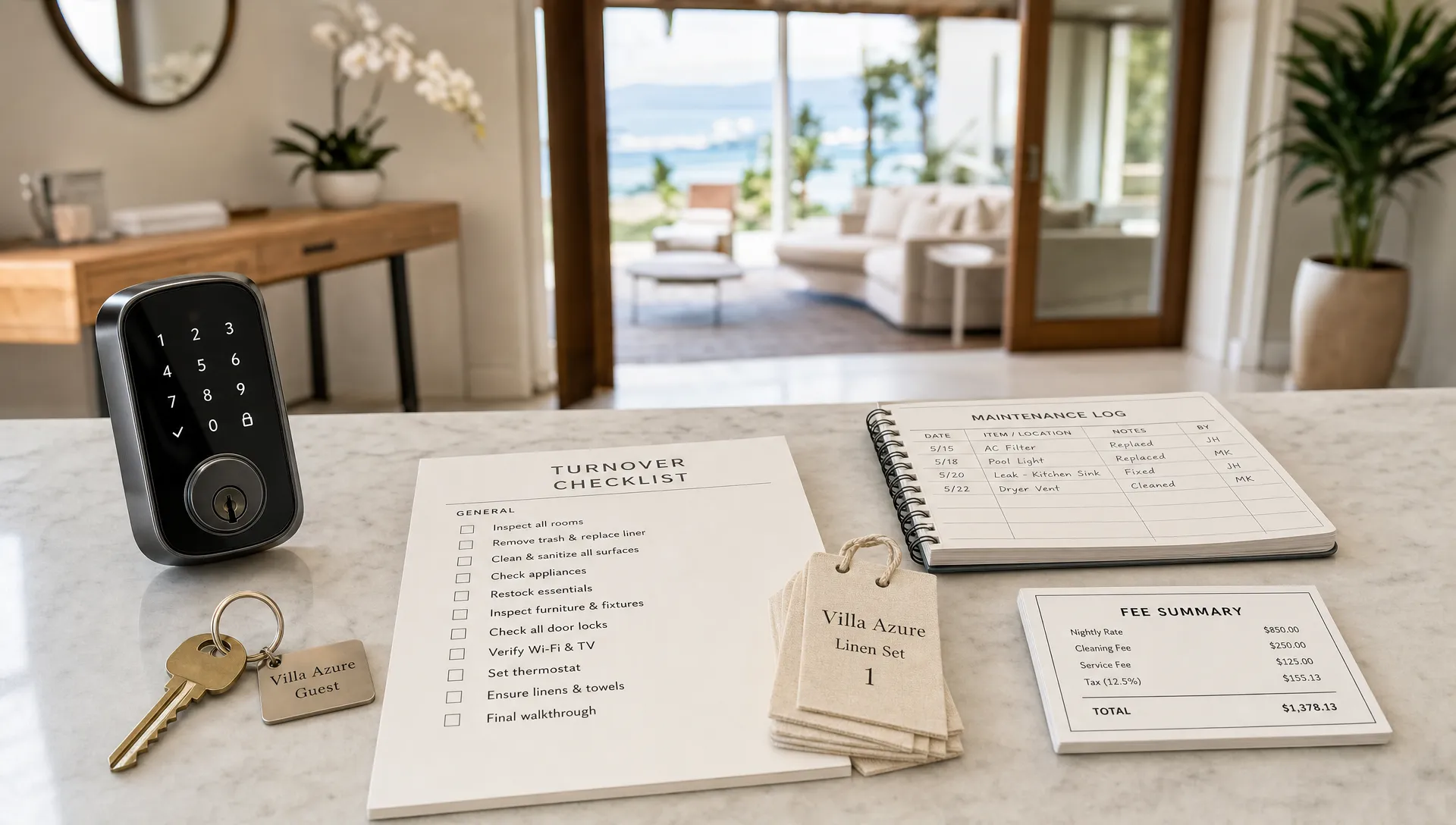
A holiday home management company should handle every revenue, guest, maintenance and risk detail that would otherwise pull you back into day-to-day operations. For luxury owners, that means more than listing your home online or answering late-night messages. The right partner builds the operating system around your property: pricing, positioning, guest screening, housekeeping, maintenance, smart access, compliance, owner reporting and review protection.
Most owners come to us after realizing self-management is not one job. It is dozens of small decisions that collide at the worst possible time, a cleaner running late, a spa heater fault before an anniversary stay, a guest asking for early check-in while your HVAC vendor is still on site. A serious manager absorbs that friction before it reaches the owner.
What should a holiday home management company handle?
A holiday home management company should manage the full guest and property lifecycle, from getting the home ready for bookings to reconciling owner revenue after checkout. In the U.S., holiday home management is often called vacation rental management or short-term rental management. The responsibilities are similar, but the execution gap between basic hosting help and luxury operations is wide.
For higher-end homes, I would not hire a company unless it can clearly own these areas.
| Management area | What they should handle | Why it matters for owners |
|---|---|---|
| Market positioning | Guest profile, listing strategy, photography direction and amenity hierarchy | Better-fit guests and stronger pricing power |
| Revenue management | Dynamic pricing, fees, length-of-stay strategy and seasonal adjustments | Higher revenue without chasing occupancy at any rate |
| Guest operations | Screening, 24/7 messaging, check-in, house rules and issue resolution | Fewer owner interruptions and better reviews |
| Housekeeping | Turnover schedules, inspections, linen standards and restocking | Consistency guests can feel immediately |
| Maintenance | Preventive checks, vendor dispatch, emergency response and owner approvals | Fewer disruptions and better asset protection |
| Compliance | Permit awareness, occupancy rules, tax coordination and insurance documentation | Lower risk in regulated markets |
| Reporting | Owner statements, revenue visibility, expense tracking and performance notes | Clear decisions instead of vague monthly payouts |
If a company only handles messaging, calendar blocks and cleaner reminders, it is a co-hosting arrangement, not full management. That may work for a simple condo. It is rarely enough for a luxury home with a pool, spa, outdoor kitchen, smart locks, premium linens, landscaping and guests paying for a frictionless stay.
1. Pre-launch positioning before the home goes live
Luxury guests do not book square footage. They book certainty. They want to know the home will look like the photos, feel private, support the trip they planned and be professionally handled if anything goes wrong.
That starts before the first listing is published. A capable manager should audit the home room by room, identify missing essentials, advise on photography, define the ideal guest profile and write listing copy that sets accurate expectations. The goal is not to make every property sound the same. A five-bedroom Scottsdale home with a private pool should be positioned differently than a coastal stay in Laguna Beach or an extended-stay home for executives near Beaverton.
At Lumina, we are picky at this stage because bad positioning creates future problems. If the listing oversells privacy, understates parking limitations or buries pool heat details, the guest experience is already at risk before arrival.
What does onboarding include?
Onboarding should include a room-by-room audit, safety review, amenities plan, supply list, photo plan, listing copy, pricing strategy, vendor handoff, owner goals and launch calendar. If the manager cannot produce a pre-launch punch list, they are probably reacting rather than operating.
This is also where the manager should be honest about the home. Not every expensive property is rental-ready. Some need better outdoor furniture, more durable linens, improved lighting, clearer house rules or smart access before they can perform at a luxury level.
2. Revenue management across seasonality, fees and expenses
Changing nightly rates is the minimum. Real revenue management looks at demand patterns, competitor movement, booking windows, minimum stays, weekday versus weekend behavior, local events and the cost of delivering the stay.
The best managers can explain what they are optimizing. Sometimes a lower nightly rate with a longer stay is smarter than a premium weekend booking with two awkward calendar gaps. Sometimes the right move is to hold rate because a high-demand period is still too far out. A manager should not treat the calendar like a slot machine.
We learned an expensive Scottsdale lesson: pool heat has to be treated as a revenue item, not a courtesy. In winter, guests value it, but gas and electricity can turn a strong booking into a thin-margin stay if the cost is buried or loosely handled. We now price, message and inspect it as its own operational category.
A strong management company should also manage revenue opportunities around early check-in, late checkout, pet policies where appropriate, extended stays and premium amenities. Those should be structured, not improvised by whoever happens to answer the guest message.
3. Guest communication, screening and arrival experience
Guest communication is where owners feel the difference fastest. A good company should respond quickly, answer accurately and know when to escalate to a human operator.
Lumina uses AI-powered guest service for 24/7 instant response with an under 10-minute average reply time, but we do not believe automation should replace judgment. If a guest has a maintenance issue, an access problem or a special occasion detail, the system needs human oversight behind it.
Smart access matters too. One owner we worked with was hesitant about smart locks because he thought keyless entry would feel impersonal. Six months in, guests were mentioning easy check-in as a positive. They did not want a key handoff. They wanted to arrive after dinner, open the door and start the trip.
Guest screening should also be part of the job. A luxury home manager should review the purpose of stay, party size, age restrictions where legally appropriate, local rules and risk signals. The point is not to make guests feel interrogated. It is to protect the property and avoid obvious mismatches.
If you are comparing self-management with full-service support, our guide to holiday rental management for owners who want less stress walks through that decision from an owner perspective.

4. Housekeeping, inspections and maintenance that protect reviews
Luxury housekeeping is not just clean floors and folded towels. It is linen quality, mattress protection, glassware checks, grill cleanliness, pool towel counts, robe rotation, scent control, dust in visible corners, hair in shower drains and whether the outdoor furniture looks guest-ready.
A holiday home management company should operate with turnover checklists and inspection standards. The cleaner should not be the final quality-control layer on a premium stay. Someone needs to verify that the home is ready for the next guest, especially when back-to-back reservations leave no margin.
Maintenance is the other half of review protection. Preventive work matters more than emergency heroics. HVAC filters, pool systems, hot tubs, irrigation, batteries, door hardware, internet equipment and appliances need recurring attention. Guests are forgiving when a team responds quickly to an unexpected issue. They are less forgiving when the issue was clearly preventable.
For a deeper look at how proactive operations protect guest experience, see our guide to vacation rental maintenance services that protect reviews.
Who should pay for repairs and supplies?
The owner typically pays for property-level repairs, replacement supplies and capital improvements, while the management company coordinates vendors, approvals and timing. The important part is clarity. Owners should know which expenses require approval, which are handled automatically under a set threshold and how documentation appears on owner statements.
I do not like vague maintenance language in contracts. If a toilet fails at 9 p.m., who dispatches the plumber? If a guest breaks outdoor furniture, who documents it? If towels keep disappearing, who tracks the pattern? Those answers should be clear before the first booking.
5. Amenities, upgrades and return on investment
A management company should help owners decide which amenities are worth the money. It should not simply tell you to add a hot tub because guests like hot tubs. The right question is whether that amenity fits the market, seasonality, nightly rate target, maintenance capacity and guest profile.
In some markets, a private pool, spa, EV charger or outdoor dining area can materially improve booking appeal. In others, the better investment may be blackout shades, faster Wi-Fi, better mattresses, upgraded cookware or a dedicated workspace for extended stays.
If you are considering premium wellness additions, Hearthside Supply's premium home wellness categories are a useful reference point for saunas, hot tubs, cold plunges, steam showers and swim spas that luxury guests recognize and search for.
The manager should help model the tradeoff. A beautiful amenity that photographs well but breaks often can become a review liability. A less glamorous upgrade, like a commercial-grade washer and dryer or stronger outdoor lighting, may protect operations week after week.
6. Compliance, insurance coordination and risk control
Short-term rental rules vary by city, county, HOA and property type. A holiday home management company should understand the rules in each market it operates in and build processes around them. That includes occupancy limits, parking instructions, noise expectations, permit awareness, tax coordination, trash schedules and guest disclosures.
The company should not pretend to be your attorney or CPA. It should know when to bring the right professional into the conversation and keep clean records so that tax and legal advisors have what they need. Owners should also review IRS guidance on renting residential and vacation property because personal use, rental use and deductions can affect reporting.
Risk control also includes insurance coordination, damage documentation, smart lock management and, where appropriate, noise monitoring. In luxury homes, the risk is not only a bad guest. It is a series of small process failures that leaves the owner exposed.
7. Owner reporting and decision support
Owners should not have to decode their own business. A management company should provide reporting that explains revenue, occupancy, expenses, maintenance activity, upcoming concerns and review themes.
A monthly payout without context is not transparency. Owners need to know whether revenue came from higher nightly rates, longer stays, better occupancy or one-time seasonal demand. They also need to see which expenses are routine and which point to larger asset decisions.
At Lumina, our job is to give owners visibility into performance, occupancy and revenue without handing them the daily workload. For a broader service-scope breakdown, our guide to vacation property management services owners need explains the operational layers owners should expect.
How to compare management models
The word management gets used too loosely. Before you sign, make sure you know which model you are buying.
| Model | What the owner still handles | What the partner handles | Best fit |
|---|---|---|---|
| Self-managed | Everything, including guest issues, pricing, vendors and emergencies | Nothing unless outsourced separately | Owners with time and operational experience |
| Co-host | Major decisions, many vendors and asset oversight | Messaging, calendar support and some turnovers | Lower-complexity homes or owners who want partial help |
| Generic property manager | Some owner oversight, especially on revenue and guest experience | Basic operations, vendor coordination and reporting | Standard vacation rentals with moderate expectations |
| Full-service luxury manager | Strategic approvals and owner-use planning | Positioning, pricing, guest care, housekeeping, maintenance, compliance and reporting | Owners who want income without running the operation |
Does full-service management have downsides?
Full-service management usually means less direct control over daily decisions, formal processes for owner stays and management fees that need to be justified by performance. For the right owner, that tradeoff is the point. You are paying to remove operational drag, protect the home and create a consistent guest experience.
The problem is not paying a management fee. The problem is paying one while still getting pulled into guest messages, cleaner issues, vendor scheduling and pricing guesses.
Questions to ask before hiring a holiday home management company
Use these questions in the interview. A serious operator will answer them directly.
- Who responds to guests after 10 p.m., and what is your average response time?
- How do you set pricing during peak season, shoulder season and event periods?
- How do you handle pool heat, spa use, EV charging, early check-in and late checkout?
- Who inspects the home after cleaning, and what is included in that inspection?
- What maintenance items are handled automatically, and what requires owner approval?
- How do you document guest damage and security deposit claims where allowed?
- Which booking platforms do you use, and how do you avoid calendar gaps?
- What owner reporting will I receive each month?
- How do you stay current on local rules, permits and tax requirements?
- What kind of properties do you decline to manage?
That last question matters. A company that accepts every home may not be protecting its brand or your property. Luxury management requires standards on both sides.

Red flags I would take seriously
Watch for vague pricing strategy, no inspection process, unclear maintenance approvals, slow response standards, weak owner reporting, no local compliance awareness and contracts that make it hard to understand who is accountable for what.
I would also be cautious with any company that talks only about occupancy. A full calendar can still underperform if rates are too low, expenses are unmanaged or guests are not a fit for the home. Luxury owners should care about net outcome, asset condition and review quality, not occupancy alone.
What Lumina handles for luxury owners
Lumina manages short-term and mid-term luxury homes across markets including Scottsdale, Manhattan Beach, Laguna Beach, Edwards, Beaverton, Moonstone and San Juan. We are built for owners who want premium management without becoming the operator.
That means we handle guest communication, booking management, cleaning coordination, maintenance dispatch, pricing optimization, listing creation, photography direction, smart home integration and owner visibility. Our team uses AI-powered operations for speed, but the service still has hospitality judgment behind it.
We also bring brand trust to the listing. Lumina has 611+ five-star reviews and Airbnb Superhost status, which helps guests feel confident before they arrive. For owners, that trust matters because a luxury booking is not only about the home. It is about the operator standing behind it.
Frequently Asked Questions
What does a holiday home management company do? A holiday home management company handles the operations of a rental property, including pricing, listing management, guest communication, housekeeping, maintenance coordination, compliance support and owner reporting.
Is a holiday home management company different from a co-host? Yes. A co-host often helps with messages, calendars and basic guest support. A full-service management company owns the broader operation, including revenue strategy, inspections, vendor coordination, risk controls and owner reporting.
Can I still use my own home if it is professionally managed? Yes. A good manager should help block owner stays, protect peak revenue periods and prepare the home properly before and after personal use.
How do I know if full-service management is worth it? It is worth considering if guest issues, cleaning coordination, maintenance calls, pricing decisions or compliance requirements are taking too much of your time. The right company should improve consistency while reducing owner involvement.
Should the manager help with permits and taxes? The manager should understand local operating requirements and keep clean records, but legal and tax advice should come from qualified professionals. Good management makes that professional review easier by keeping documentation organized.
List your property with Lumina
If you own a luxury home and want the income without becoming the operator, we can review your property, market, amenity mix and likely management scope. Get a free revenue estimate or ask about listing your property with Lumina by emailing newhomes@staywithlumina.com or calling (602) 905-7540.
Luxury homes are unforgiving in the best way: guests notice everything, and owners feel every operational miss. We built Lumina around the details that protect both sides, because the best management is quiet, consistent and accountable.
- Shariann