
vacation rentals websites
Vacation Rentals Websites: How to Book Securely
The safest way to use vacation rentals websites is to verify the operator, confirm the full price and cancellation terms, then pay through a checkout you reached independently. Attractive photos don't establish who controls a home or who will help if your arrival goes wrong.
At Lumina, we manage private homes rather than hotel rooms. That makes booking security about more than protecting a card number: you also need confidence that the home, access instructions and support team match what you purchased. Here's the process we'd use before committing to a stay.
Who is responsible when you book a rental?
A vacation rental website might advertise a property, process your payment, manage the home or do only one of those jobs. Establish which role it plays before treating its branding as a guarantee.
| Website type | What it typically does | What to establish before paying |
|---|---|---|
| Booking marketplace | Connects travelers with independent hosts or managers | Who operates the home and which booking protections apply |
| Property manager's direct website | Markets homes managed by that business | Who receives payment and handles problems during the stay |
| Individual owner's website | Offers a property directly | Whether the owner is independently verifiable and has a clear agreement |
| Metasearch or comparison website | Collects listings and redirects travelers elsewhere | Which business completes and supports the reservation |
None of these models is automatically safe or unsafe. Follow the transaction from the listing to the company taking payment, rather than assuming every website involved has the same responsibilities.
How can you verify vacation rentals websites?
Start with the operator's identity, not the property's styling. Look for a business name, working contact information, written rental terms and an explanation of who manages the home.
Search the business independently. Compare its contact details across its official website and established public profiles. A newly created website isn't proof of fraud, but a business claiming years of operation should have a history you can investigate.
Next, check whether the listing tells a consistent story. A reverse-image search can reveal photos copied from a sales listing or a different destination. Matching photos across multiple booking channels can be legitimate, so compare the named manager and property details before drawing conclusions.
Ask one property-specific question: Is the pool exclusively for this home? How many vehicles fit in the driveway? Who handles an access problem after hours? An accurate, specific answer is more useful than a polished greeting, though responsiveness alone doesn't prove legitimacy.
Our guide to vetting a property rental company goes deeper into checking the operator behind a listing. Here, the next step is making sure that verified identity survives the move into payment.
Does the payment request match the booking?
Secure bookings on vacation rentals websites require continuity: the company you investigated should match the merchant, agreement and payment instructions you receive.
If you found a home through a marketplace, keep the reservation and payment within its authorized process. A message offering a discount if you cancel and pay elsewhere changes the transaction and may remove protections you expected.
Direct booking is different. You can legitimately book through an established manager's own website, but navigate there independently. Don't treat a payment link in an unsolicited message as proof that you're dealing with that manager.
Before entering payment details, check the domain carefully. HTTPS encrypts a connection; it does not establish that the recipient is trustworthy. A misspelled address can still display a padlock.
Use a payment method with a documented dispute process where available. Credit cards can provide a route to challenge certain charges, but eligibility and deadlines depend on the circumstances and issuer. They don't guarantee reimbursement.
Avoid gift cards, cryptocurrency or payments to an unexplained individual account. A wire request deserves independent verification because transfers can be difficult to recover. The Federal Trade Commission's rental scam guidance explains why copied listings and pressure to send money warrant caution.
If payment instructions change, stop. Contact the operator using a number you found independently, not the replacement number inside the same message.
What will the entire stay cost?
The nightly rate isn't your final budget. Compare vacation rentals websites using the same dates, guest count, stay length and required amenities, then inspect the complete checkout total.
Cleaning charges, booking fees, taxes and required property charges can change the comparison. Optional extras need a separate decision: a pool isn't necessarily heated, and an available early check-in isn't necessarily complimentary or guaranteed.
Here's an illustrative calculation, not a Lumina quote or a local tax estimate:
| Cost item | Illustrative amount |
|---|---|
| Four nights at $550 | $2,200 |
| Cleaning | $250 |
| Booking fee | $150 |
| Required property charge | $100 |
| Taxes | $270 |
| Total stay cost | $2,970 |
| Effective cost per night | $742.50 |
A refundable security deposit or card authorization should be identified separately. Ask whether it's a charge or a temporary hold, when it's released and what could trigger a deduction. Even a refundable amount can affect available credit during your trip.
For a longer stay, establish whether utilities, parking, additional cleaning or pet charges affect the quote. Save the itemized total before submitting payment so you can compare it with the receipt afterward.
A useful rule: if an amenity is essential to your trip, get its availability, conditions and price in writing before booking.
Can you explain the cancellation policy in plain English?
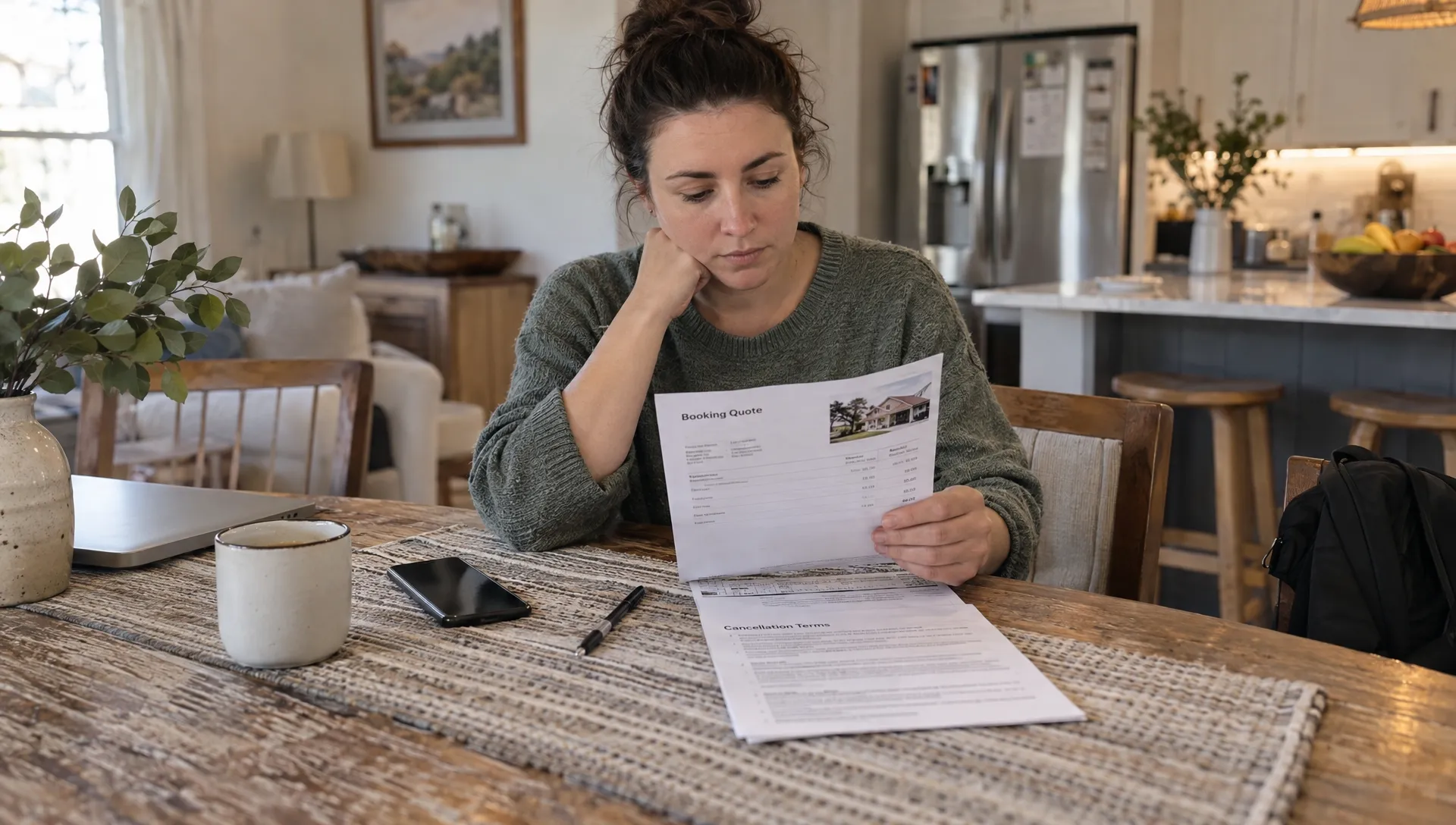
Before paying through vacation rentals websites, translate the cancellation terms into dates and amounts. “Flexible” or “partially refundable” isn't enough information to make a financial decision.
You should be able to answer three questions: What is the last deadline for the refund I want? Which charges are excluded? What happens if I shorten or change the stay rather than cancel it?
Check the deadline's time zone. A policy tied to local property time can create a different cutoff from the one you expect at home. Also confirm whether moving dates creates a new reservation or changes the original terms.
Separate guest cancellation from operator cancellation. Ask what happens if the home becomes unavailable and whether any proposed replacement requires your approval. Don't assume “comparable accommodation” means the same neighborhood, bedroom layout or private amenities.
Travel insurance and optional cancellation products have their own exclusions. If your concern is a particular event, such as illness, a work obligation or severe weather, read the applicable coverage rather than assuming every disruption qualifies.
Save the policy version attached to your booking. A screenshot should include the relevant wording and reservation context, not just a cropped headline promising refunds.
Could local rules or house restrictions disrupt the stay?
A genuine property can still be unsuitable for your plans. Local rental rules, building restrictions and house policies may affect minimum stay length, occupancy, parking or visitor access.
When comparing vacation rentals websites, don't assume that a visible listing proves every proposed use is permitted. Where a jurisdiction requires a registration or permit number, look for it and check it through the relevant government source when a public lookup is available. Requirements differ by location and rental type.
Be equally precise about what you intend to do. A home that sleeps eight may not allow eight additional dinner guests. A family reservation doesn't automatically permit a catered celebration, commercial photography or filming.
Corporate travelers and production crews should disclose work-related use before payment. Ask about deliveries, equipment storage, vehicle limits and any approvals needed for people who aren't overnight guests.
For extended stays, additional agreement terms or local legal requirements may apply. Don't assume a month-long reservation follows the same rules as a weekend booking.
Get exceptions in writing. A casual assurance that “it should be fine” isn't a reliable substitute for an approved guest count, visitor arrangement or permitted use documented with the reservation.
What confirmation and arrival information should you receive?
Your confirmation should connect the property, dates, guest count, total price and operator to a reservation reference. It should also identify payment status, remaining balances and how to reach support.
Reputable vacation rentals websites may withhold an exact address or entry code until an appropriate point before arrival. That isn't inherently suspicious. What matters is knowing when you'll receive those details and what happens if they don't arrive.
We use smart-lock keyless access at Lumina. Our operational priority is making sure guests understand how arrival works and have a support route if access fails. Technology removes a key handoff, but it doesn't remove the need for clear instructions.
Ask whether you need an app, mobile data or advance identity verification. Share legitimate verification information only through the operator's documented process. An unexpected text asking you to upload identification or card details deserves an independent check first.
Save arrival instructions somewhere accessible without reliable reception. Don't post entry codes in a large group chat or forward them to outside vendors without permission.
If you're narrowing down an entire-home stay, use our guide to reading vacation rental listings carefully to check the property details alongside these security checks. Compare the home you want with the experience you're actually authorized to book.
How does this work for a family booking a private home?
Consider a hypothetical family trip to Scottsdale. The parents want a private pool, grandparents need a bedroom without stairs and everyone arrives on a late flight. The listing looks suitable, but those three requirements create different verification tasks.
The pool question requires confirmation of exclusive use, heating availability and any additional charge. The bedroom question requires a clear description of the route from parking to the bedroom and bathroom, not simply a property labeled “single level.” Late arrival requires documented access instructions and an after-hours support channel.
This is where vacation rentals websites need to provide more than attractive search filters. “Pool,” “accessible” and “self check-in” don't necessarily answer the family's actual questions.
At Lumina, we offer entire homes and 24/7 guest messaging. We also offer early check-in and late checkout subject to availability. Those are useful service features, but we still recommend confirming property-specific requirements before paying, especially anything that would make the stay unworkable if unavailable.
The practical lesson is to rank your nonnegotiables before booking. Confirm those first, then compare design, extras and price. A lower rate doesn't compensate for a home that can't accommodate your group safely or comfortably.
How should you vet services coming into the home?
Booking security extends to anyone invited inside: massage therapists, private chefs, childcare providers or other independently arranged services. A confirmed rental doesn't automatically authorize outside vendors or establish that they're qualified.
First, ask the property manager whether the service is permitted. Then verify the provider separately, including relevant qualifications, insurance, identity and cancellation terms. Establish who will attend and how you can contact the business if plans change.
For a concrete example of useful disclosures, Lifeforce's therapist safety and vetting policy describes its approach to qualifications, insurance, background checks and conduct. It's a London-based service; the relevant takeaway for a U.S. stay is the level of information to request, not an assumption that the provider serves your destination.
When vacation rentals websites mention concierge support, ask whether the operator supplies a service, refers an independent provider or simply shares local suggestions. Those arrangements carry different responsibilities.
Don't give a vendor unrestricted entry credentials by default. Coordinate an approved arrival method with the manager and protect other guests' privacy. If a provider substitutes a different person at the last minute, verify the change before admitting them.

What should you do if something looks wrong after payment?
Act promptly and preserve records. If a message demands another payment, threatens immediate cancellation or introduces new bank details, don't pay simply to protect the original booking.
Return to the verified communication channel. Ask the operator to explain the request against your reservation and itemized receipt. If the booking originated on a marketplace, use that platform's official support route rather than a number supplied in the suspicious message.
For a missing reservation, unavailable property or serious mismatch, document the facts: dates, screenshots, payment records and the response you received. State the resolution you're requesting without burying it in a long account of the trip.
When vacation rentals websites or operators can't resolve a payment issue, contact your card issuer or payment provider promptly. Ask about applicable dispute requirements and deadlines. Reporting suspected fraud doesn't automatically recover funds, so don't wait indefinitely for repeated promises.
If you're stranded, prioritize safe accommodation while documenting reasonable replacement costs. Whether those costs are recoverable depends on the agreement, applicable protections and circumstances.
Never let a refund discussion delay action on an immediate safety concern. Leave an unsafe situation and contact emergency services when necessary.
Frequently asked questions
Is booking directly with a property manager safe?
Direct booking can be safe when you independently verify the manager, use its legitimate checkout and receive clear written terms. It isn't automatically safer or cheaper than a marketplace. Compare the complete price, cancellation conditions and available payment protections before deciding.
What is the safest way to pay for a vacation rental?
Use the verified operator's or marketplace's authorized checkout and a payment method with a documented dispute process where available. Avoid payment requests that can't be independently explained. A familiar payment brand doesn't make an unfamiliar recipient trustworthy.
What should I save before confirming a reservation?
Save the listing, itemized quote, cancellation terms, rental agreement and written answers about essential amenities. After paying, retain the receipt and confirmation. When using vacation rentals websites, keep a record of which business accepted payment and which team is responsible for your stay.
Book with the details settled
A secure reservation gives you a clear chain of responsibility: an identifiable operator, an authorized payment, written terms and an arrival plan you understand.
At Lumina, we offer individually selected private homes, keyless access and 24/7 guest messaging. Book your stay with Lumina and confirm the property-specific details that matter to your group before completing your reservation.
My advice is to spend as much attention on the booking terms as the photos. We manage homes people choose for privacy and time together, and clear expectations help protect both.
Shariann