
short term rental management
Short Term Rental Management for Luxury Homeowners

Short term rental management is not just a way to outsource guest messages. For luxury homeowners, it is the operating layer that protects nightly rate, guest experience, maintenance standards, compliance, and owner peace of mind. The right partner should increase the value of the home as an income-producing asset, not turn it into a generic rental with nice photos.
If you own a second home, investment property, or luxury vacation home, the question is not whether someone can list it online. Almost anyone can do that. The real question is whether the property can perform consistently without you chasing cleaners, answering midnight messages, managing pool vendors, or guessing at pricing.
What short term rental management means for luxury homeowners
A short term rental management company handles the day-to-day operation of a furnished property rented to guests for shorter stays. For a luxury homeowner, that should include much more than bookings.
A true luxury operator manages positioning, pricing, guest communication, cleaning quality, maintenance response, smart home access, owner reporting, and local market strategy. Done well, it feels quiet from the owner side because the work is happening before problems reach you.
At Lumina, we see the difference between managing a rental and operating a luxury hospitality asset every week. A guest paying a premium nightly rate does not separate the house from the service. If the entry code fails, the spa is cold, the linens feel tired, or no one answers quickly, the property gets blamed.
That is why luxury short term rental management has to combine hospitality, asset protection, and revenue management.
What does a short term rental manager actually do?
A short term rental manager should handle every operational responsibility required to keep the property booked, guest-ready, legally aware, and financially accountable. For a luxury home, the manager should also protect the brand perception of the property.
Here is the practical scope I would expect from a serious operator:
| Management function | Generic version | Luxury standard |
|---|---|---|
| Listing setup | Basic photos and a copied description | Strategic positioning, professional presentation, amenity-led storytelling, and house-specific details |
| Pricing | Set-and-forget nightly rates | Dynamic pricing based on seasonality, events, lead time, length of stay, and owner goals |
| Guest messaging | Delayed replies or outsourced scripts | Fast, accurate, hospitality-grade communication with escalation when needed |
| Cleaning | Turnover after checkout | Detailed inspection, restocking, linen standards, damage checks, and readiness confirmation |
| Maintenance | React when something breaks | Preventive vendor coordination, fast dispatch, and owner communication when decisions matter |
| Access | Key exchange or basic code | Smart lock keyless entry with clear instructions and backup processes |
| Owner visibility | Monthly payout only | Reporting on occupancy, revenue, issues, and performance trends |
If you want a deeper breakdown of what should sit inside a full-service model, our guide to vacation rental property management for hands-off owners walks through the responsibilities owners should not have to carry themselves.
Why luxury homes cannot be managed like standard rentals
A luxury home has a different risk profile than a small condo or entry-level vacation rental. The nightly rate is higher, the guest expectations are sharper, and the property itself is more expensive to maintain.
Small mistakes cost more.
A missed hot tub service can affect a romantic anniversary stay. A poorly worded check-in message can frustrate an executive arriving late after a flight. A pool heating mistake in Scottsdale can turn a profitable winter stay into a thin-margin booking. We learned that lesson early: if utilities, seasonal amenity costs, and guest expectations are not priced into the rate structure, the owner absorbs the pain.
Luxury guests also review details that average guests may overlook. They notice whether outdoor cushions are clean, whether kitchen tools match the size of the home, whether the Wi-Fi can support remote work, and whether the entry process feels seamless.
One owner we worked with was hesitant about smart locks. He thought they might make the stay feel impersonal. After we moved the property to keyless access, guest feedback improved because arrivals became easier. No one had to coordinate a handoff. No one waited outside. The luxury was not the technology itself, it was the absence of friction.
That is the standard luxury homeowners should expect.

Self-managed vs full-service short term rental management
Self-managing can work when the property is simple, nearby, and the owner enjoys hospitality work. I have no issue with owners who want to be hands-on. Some are excellent hosts.
But luxury homeowners usually do not buy a second home to become the night manager, revenue analyst, cleaner coordinator, and maintenance dispatcher. That is where full-service management becomes less of an expense and more of an operating system.
| Question | Self-managed luxury rental | Full-service luxury management |
|---|---|---|
| Who answers guests at 11:40 p.m.? | Usually the owner | Management team or AI-supported guest operations with escalation |
| Who adjusts rates for local demand? | Owner, often manually | Revenue strategy with dynamic pricing and market review |
| Who inspects after cleaning? | Owner if local, otherwise trust-based | Turnover process with quality checks |
| Who handles vendor access? | Owner coordinates | Manager schedules, grants access, and follows up |
| Who protects review quality? | Owner reacts after feedback | Manager prevents issues before reviews happen |
| Who tracks owner performance? | Owner compiles data | Manager reports performance, occupancy, and revenue visibility |
The tradeoff is control. Self-management gives you direct involvement. Full-service management gives you leverage.
The right choice depends on your time, distance from the property, tolerance for interruptions, and the level of guest experience you want attached to your home. If your goal is passive income with premium standards, self-management rarely stays passive for long.
The operating system behind a high-performing luxury rental
Most underperforming luxury rentals are not underperforming because the house is bad. They underperform because the operation is thin.
A strong short term rental management company builds systems around five areas.
Positioning and launch strategy
Luxury homes need to be positioned before they are priced. A five-bedroom Scottsdale home with a pool, outdoor dining, and workspaces should not be marketed the same way as a beach cottage in Laguna Beach or an executive stay in Beaverton.
The listing should answer the buyer’s real questions quickly:
- Who is this home best for?
- What amenities justify the premium rate?
- How private is the stay?
- Is the home suitable for families, couples, corporate guests, or extended stays?
- What will arrival, parking, sleeping, working, and cooking feel like?
Generic listing copy talks about comfort and convenience. Good positioning names the specific reasons a guest should choose that home over a hotel suite or another rental.
Revenue management
Luxury pricing is not about being expensive. It is about being precise.
Rates should shift based on demand, seasonality, events, booking window, length of stay, day of week, and amenity costs. Minimum stays matter too. A two-night gap might make sense in one season and create operational drag in another.
For owners, the most important metric is not gross revenue. It is net owner income after cleaning, utilities, maintenance, platform costs, management fees, and wear.
This is where many owners misread performance. A calendar can look busy while the property is earning less than it should. A good manager knows when to protect rate, when to open availability, and when to decline revenue that creates more risk than upside.
Guest communication
Speed matters, but accuracy matters more.
Lumina uses AI-powered guest service with 24/7 instant response and an under-10-minute average reply time, supported by human oversight when a situation needs judgment. That combination matters because luxury guests do not want call centers, hold music, or delayed email chains.
The goal is simple: answer before frustration forms.
For corporate travelers, executives, and international guests, this level of operational reliability mirrors what they expect from other premium travel services. Someone arranging airport transfers or reliable car hire in South Africa for a business trip expects the same promptness when accessing a high-end rental home in the United States.
Cleaning and inspection standards
Cleaning is where many luxury rentals lose trust.
A cleaner can finish a turnover and still miss the details that drive reviews: fingerprints on glass doors, sand in outdoor seating, a grill that looks used, low supplies, a stained pillow protector, or a patio that was not reset after wind.
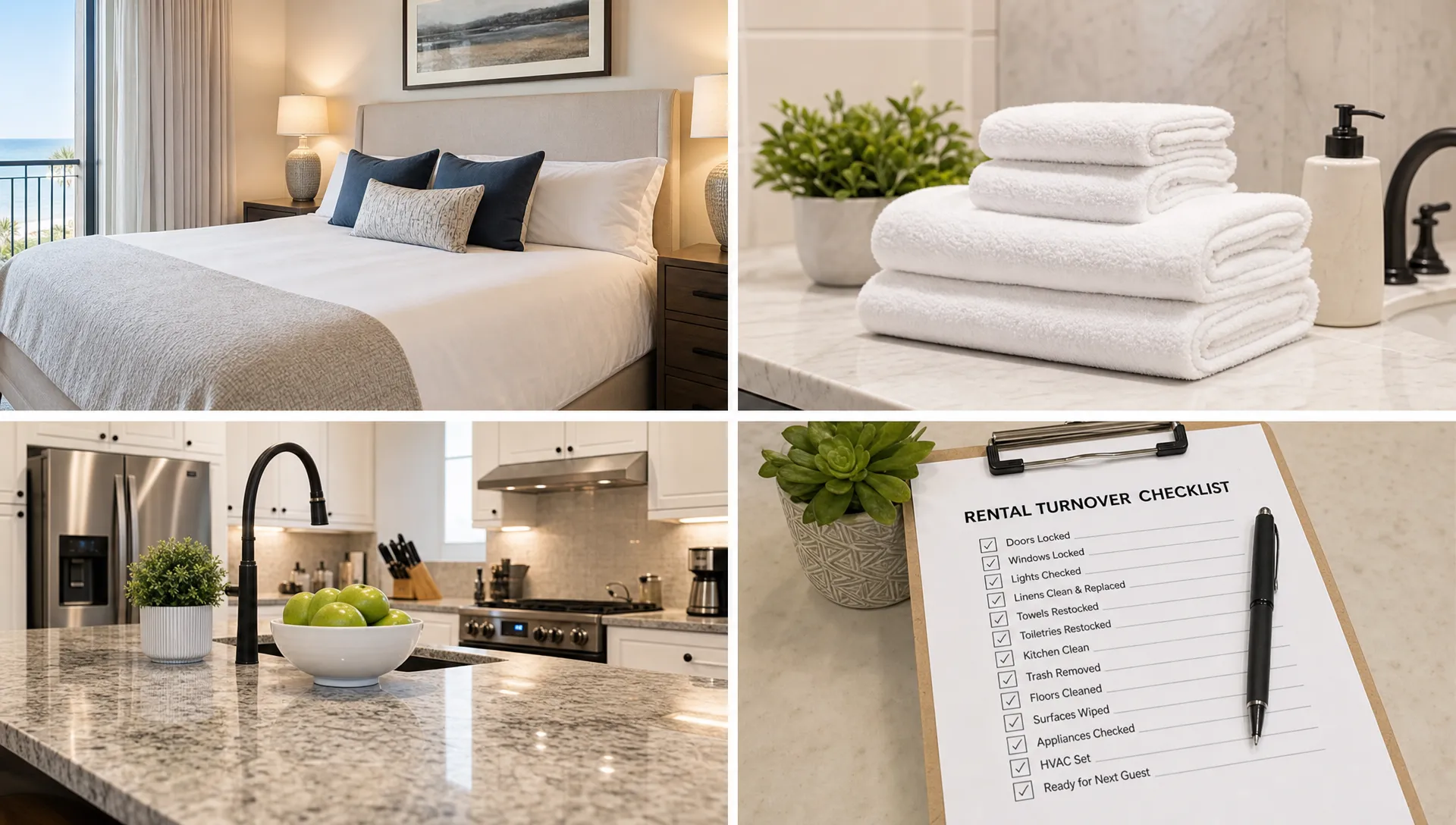
Luxury turnover should include inspection, inventory awareness, linen consistency, restocking, and maintenance flagging. The cleaner is not just cleaning. They are part of the guest experience and owner protection system.
Maintenance and smart home technology
Luxury homes have more systems: pools, hot tubs, outdoor lighting, HVAC zones, irrigation, EV charging at select properties, security devices, smart locks, and connected thermostats.
The property manager needs to coordinate these systems without making the guest feel monitored or the owner feel blind. Smart locks improve arrival. Noise monitoring can protect the property when used appropriately. Connected devices can help detect issues before they become expensive.
Safety matters here too. For homes with pools or spas, owners should be aware of public safety guidance such as the U.S. Consumer Product Safety Commission’s Pool Safely campaign, especially when hosting families.
If you want to pressure-test your current setup, our article on what great vacation rental management should handle is a useful checklist.
Soft owner note: If your property is high-end and you are still coordinating cleaners, guest questions, pricing, and vendor access yourself, the operation is probably taking more from you than it needs to. We are happy to look at the home, the market, and the current numbers, then tell you plainly whether management is likely to make sense.
How short term rental management protects net income
The best management companies do not chase occupancy at any cost. They protect net income.
That distinction matters. A heavily discounted booking can fill the calendar while increasing wear, utilities, cleaning complexity, and neighbor risk. A luxury manager should understand which bookings are worth having and which ones quietly erode value.
Common hidden costs include:
| Hidden cost | Why it hurts owners | How good management reduces the risk |
|---|---|---|
| Underpriced utilities | Pools, spas, HVAC, and large homes can consume margin | Price rules, seasonal amenity fees, and minimum stay strategy |
| Poor guest fit | The wrong group can create damage, noise complaints, or bad reviews | Screening, house rules, communication, and platform settings |
| Weak turnover checks | Problems get discovered by the next guest | Inspection processes and cleaner accountability |
| Reactive maintenance | Small issues become emergency repairs | Preventive schedules and vendor relationships |
| Slow replies | Guests become frustrated before help arrives | 24/7 response systems and escalation paths |
| Owner time | Time becomes the invisible expense | Delegation of daily operations and reporting |
Owners should also separate rental operations from tax advice. The IRS has detailed guidance for residential rental property in Publication 527, but every owner’s situation is different. A property manager can provide operational reporting, while your CPA should advise on tax treatment, depreciation, personal use, and deductions.
What to look for in a luxury short term rental management partner
A polished website is not enough. When comparing short term rental management companies, ask operational questions.
I would start here:
- How quickly do you respond to guest messages, and what happens after hours?
- Who inspects the home after cleaning?
- How do you price pool heat, hot tub use, holidays, events, and gap nights?
- What smart home systems do you install or manage?
- How do you handle maintenance approvals?
- How do you protect the home from poor-fit bookings?
- What reporting will I receive as an owner?
- Which markets do you already operate in, and what have you learned there?
Listen for specifics. Generic managers talk about maximizing revenue and delivering five-star stays. Operators talk about linen backup, HVAC failures, guest arrival timing, local vendor response, minimum-stay rules, and what they do when a cleaner calls out.
That is the difference.
For a more detailed evaluation framework, we wrote a separate guide on how to compare vacation rental management companies without getting distracted by headline fees.
Is full-service management worth the fee?
Full-service management is worth the fee when the manager increases net income, protects the asset, improves guest experience, and removes meaningful work from the owner. It is not worth it if the company only forwards messages, schedules cleaners, and takes a percentage.
For luxury homeowners, I would evaluate value in four categories:
| Value category | What to measure |
|---|---|
| Revenue lift | Better rates, better calendar strategy, longer stays, premium positioning |
| Time saved | Fewer guest interruptions, fewer vendor calls, less owner involvement |
| Risk reduction | Better guest fit, faster issue response, cleaner documentation |
| Asset protection | Preventive maintenance, smart access, inspections, review protection |
The fee should be judged against the outcome, not in isolation. A low-fee manager who leaves money on the table or lets standards slip can cost more than a premium manager who operates the property correctly.
How Lumina approaches luxury short term rental management
Lumina is built for owners who want income without self-managing and guests who expect more than a hotel room.
We manage private luxury homes across premium U.S. destinations including Scottsdale, Manhattan Beach, Laguna Beach, Moonstone, Edwards, Beaverton, and San Juan. Our model is intentionally hands-on where it matters and technology-enabled where it removes friction.
For owners, that means full-service management across guest communication, booking management, cleaning coordination, maintenance dispatch, pricing optimization, listing creation, and photography. We also use smart home integrations such as smart locks, noise monitors, and connected devices to make access smoother and protect the property.
On the guest side, Lumina’s brand trust matters. We bring 611+ five-star reviews, Airbnb Superhost credibility, proactive communication, and concierge-level support. That reputation does not happen by accident. It comes from small operational decisions repeated every stay.
We also do not try to make every home look the same. A luxury home in Manhattan Beach should not feel like a Scottsdale desert retreat. A San Juan property should not be positioned like an Edwards mountain stay. The home, market, seasonality, and likely guest profile all shape the strategy.
Pros and cons of hiring a short term rental manager
Hiring a manager is not automatically the right decision for every homeowner. Here is the honest version.
| Pros | Cons |
|---|---|
| Less day-to-day owner involvement | You give up some direct control over operations |
| Stronger guest response coverage | Management fees reduce gross payout |
| Better pricing and positioning discipline | The quality of the company matters a lot |
| Cleaner vendor coordination | You need clear expectations upfront |
| More consistent review protection | Not every manager understands luxury homes |
| Better asset oversight when owner is remote | Poor managers can over-standardize the home |
My bias is clear: luxury homes should be professionally operated unless the owner has the time, proximity, and temperament to manage hospitality at a high level. But I would rather tell an owner no than take on a home where expectations, regulations, or economics do not make sense.
Frequently Asked Questions
What is short term rental management? Short term rental management is the professional operation of a furnished property rented for short stays. It usually includes listing setup, pricing, guest communication, cleaning, maintenance coordination, owner reporting, and compliance awareness. For luxury homes, it should also include brand positioning and asset protection.
How much does short term rental management cost for luxury homes? Costs vary by market, property type, and service scope. Some companies charge a percentage of rental revenue, while others may structure fees differently. Owners should focus less on the fee alone and more on projected net income, service depth, review protection, and time saved.
Can I still use my home personally if it is professionally managed? In most management relationships, owners can block personal dates. The important part is planning. If you use the home during peak revenue periods, that will affect income. A good manager should help you understand the tradeoff before the calendar fills.
Do luxury vacation homes need permits for short term rentals? Many markets require permits, licenses, tax registration, inspections, or specific operating rules. Requirements vary by city, county, HOA, and property type. Before launching, confirm the local rules and work with a manager who understands the market.
What makes luxury short term rental management different from standard Airbnb management? Luxury management requires higher service standards, faster communication, better preventive maintenance, premium positioning, stronger guest fit controls, and more careful protection of the home. The operation has to match the nightly rate.
Considering short term rental management for your luxury home?
If you own a luxury vacation home and want it professionally operated, start with a clear revenue and operations review. The goal is not to list the property as fast as possible. The goal is to understand what the home can earn, what standards it needs, and whether the management model protects your time and asset.
You can learn more about Lumina or contact us directly for a free revenue estimate. Email sales@staywithlumina.com or call (602) 905-7540.
We will give you a practical view of the opportunity, the operational requirements, and the risks we would want to solve before taking the property live.
I care about this topic because I have seen beautiful homes underperform for avoidable reasons: weak pricing, slow replies, inconsistent cleaning, and owners trying to manage from a different city. Luxury guests are not unreasonable, but they are precise. When the operation is precise too, the home has a much better chance of performing the way it should.
— Shariann