
short term rental management companies
How to Compare Short Term Rental Management Companies
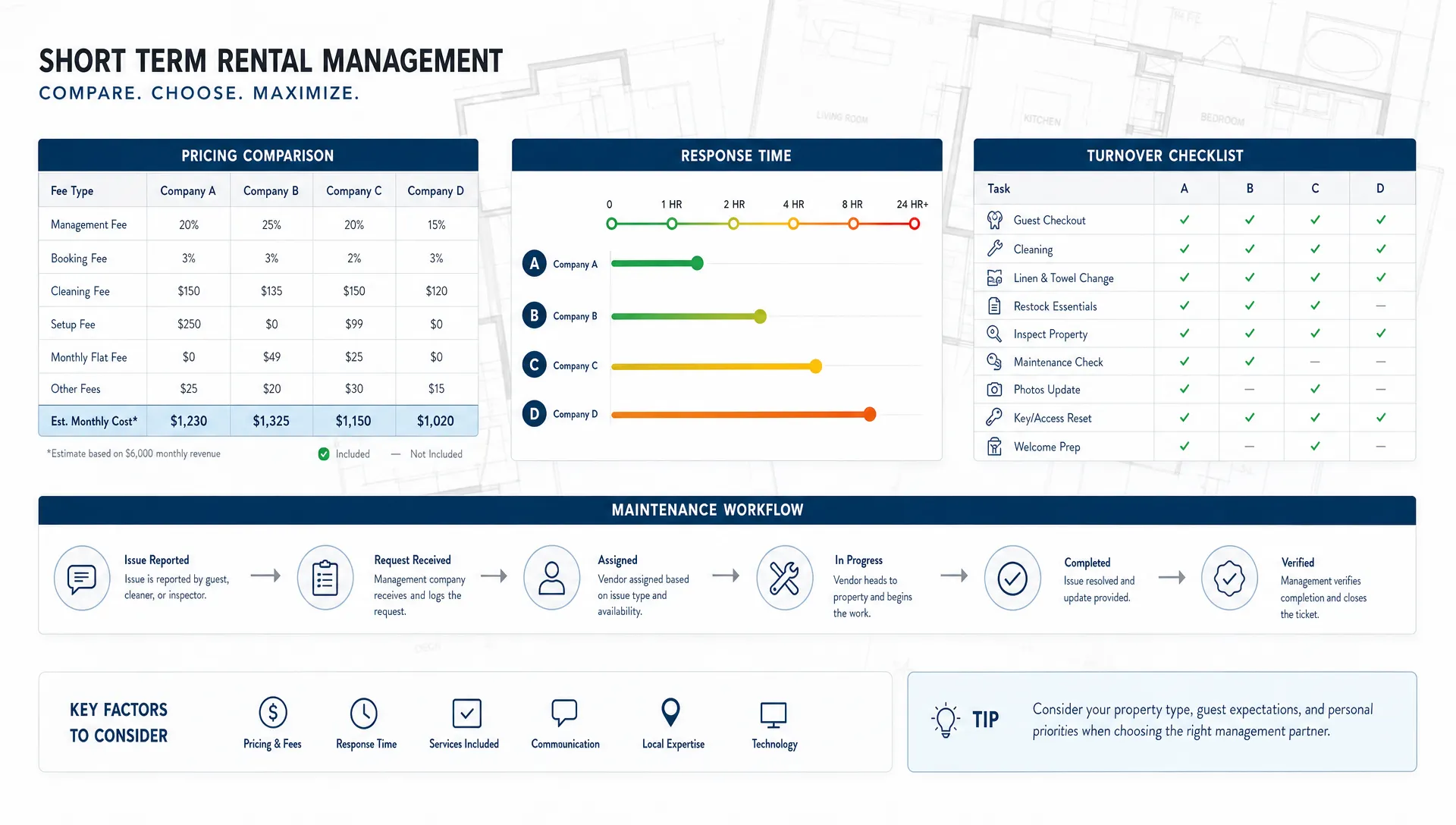
The best short term rental management companies are not the ones with the lowest fee. They are the ones that protect your asset, create the strongest net outcome, and remove the daily operating burden from you as the owner.
A short term rental management company should handle pricing, guest communication, cleaning, maintenance, listing strategy, compliance awareness, reporting, and guest experience. For luxury homes, that bar gets higher. A basic co-host can answer messages. A true operator protects the value of the home while making the stay feel effortless to the guest.
What separates good short term rental management companies from average ones?
Average managers sell convenience. Good managers sell performance, consistency, and accountability.
That distinction matters because a luxury home is not a commodity. If your property has a pool, designer furnishings, ocean proximity, mountain access, EV charging, smart home systems, or extended-stay potential, the management company needs to understand more than booking calendars. They need to understand how those features translate into pricing, guest expectations, maintenance planning, and reviews.
We see this every week at Lumina. Owners often come to us after realizing that a cheaper management option still left them making decisions about cleaners, guest issues, repairs, calendar gaps, or pricing. That is not full-service management. That is outsourced messaging with owner homework attached.
If you are still defining what should be included, our guide to short term rental property management breaks down the core operating responsibilities in more detail.
How to compare short term rental management companies
Compare short term rental management companies by net revenue, service scope, guest response quality, local market knowledge, reporting transparency, contract terms, and how they protect the home. Do not start with the management percentage alone.
A low fee can look attractive on paper and still cost you more through weak pricing, poor photography, slow guest replies, loose cleaning standards, or preventable maintenance issues. A higher-quality operator may charge more but produce better occupancy, stronger nightly rates, fewer owner headaches, and better guest reviews.
Use this scorecard before signing anything.
| What to compare | Weak answer | Strong answer | Why it matters |
|---|---|---|---|
| Revenue strategy | We adjust prices as needed | Clear pricing process by season, event, length of stay, and amenity value | Nightly rate strategy drives owner income |
| Guest communication | We respond during business hours | 24/7 coverage with fast response expectations and escalation rules | Reviews often depend on speed and clarity |
| Cleaning standards | We have cleaners | Documented turnover process, inspections, linen standards, and issue reporting | Cleanliness is the fastest way to win or lose reviews |
| Maintenance | Call us if something breaks | Preventive checks, vendor coordination, approval thresholds, and emergency process | Luxury homes need protection, not reaction only |
| Reporting | Monthly statement | Clear visibility into revenue, occupancy, expenses, and performance | Owners should not chase basic financial answers |
| Contract terms | Standard agreement | Clear fee structure, termination terms, owner access rules, and service obligations | The contract shows how accountable the company is |
| Brand positioning | Listed like every other rental | Property positioned for the right guest, stay type, and market segment | Luxury homes need curation, not generic copy |
What should a short term rental manager actually handle?
A proper manager should own the operation from guest inquiry through checkout, then keep improving the property based on performance and review feedback.
For a luxury home, I expect the management scope to include:
- Listing creation, photography direction, description strategy, and platform setup
- Dynamic pricing and calendar management across relevant booking channels
- Guest screening, pre-arrival communication, stay support, and checkout messaging
- Cleaning coordination, turnover quality control, restocking, and laundry standards
- Maintenance dispatch, vendor communication, and urgent issue handling
- Owner reporting, revenue visibility, and recommendations for property improvements
The key phrase is own the operation. If the company says they manage your rental but still expects you to approve every small guest request, coordinate basic repairs, remind cleaners, or manually adjust pricing, you are not buying full-service management.
This is especially important for second-home owners who live out of market. A vacation home in Scottsdale, Laguna Beach, Manhattan Beach, Edwards, Beaverton, Moonstone, or San Juan needs local operating judgment. A guest waiting outside with a lock issue does not care that the owner is three time zones away.
How do you know if the pricing strategy is real?
Ask the company to explain how they would price your property during a normal week, a peak-demand week, a shoulder-season gap, and a longer stay request. If they cannot explain the difference without vague language, the pricing strategy probably is not mature.
Strong pricing is not just raising rates on holidays. It includes minimum-stay strategy, gap-night logic, midweek discounts when appropriate, premium pricing for high-demand windows, and clear rules for amenity costs.
We learned the hard way that pool heat in Scottsdale can damage an owner’s margin if it is treated casually. Guests love warm pools in cooler months, but the cost has to be built into the pricing model or handled through a clear add-on process. Now we treat amenities like pool heat as part of the revenue and cost conversation from the beginning, not as an afterthought.
That is the kind of operational detail you want to hear in a proposal. Not just higher occupancy. Not just optimized rates. Real examples of how the company protects margin.
If you own a premium home and want to understand how luxury management differs from standard hosting, we wrote a separate guide on short term rental management for luxury homeowners. It is a useful companion before you compare proposals.
Questions to ask before signing with a management company
The best way to compare companies is to ask specific questions and listen for operational answers. A polished sales call is easy. A detailed operating answer is harder to fake.
Ask these questions before you sign:
- Who responds to guests at 10 p.m. if there is an access, Wi-Fi, heat, pool, or noise issue?
- What is your average guest response time, and how do you measure it?
- How do you choose cleaners, inspect turnovers, and handle missed details?
- What repairs can you approve without owner permission, and where is the approval threshold?
- How do you price longer stays versus weekend leisure stays?
- Which booking channels will you use, and why are those right for this property?
- What reports will I receive, and how often?
- What happens if I want to use my own home during peak season?
- How can I leave the agreement if the service does not meet expectations?
You are not looking for perfect answers. You are looking for clear answers. If the company gets defensive when you ask about response times, vendor oversight, or termination terms, that tells you something.
What luxury homeowners should verify beyond the proposal
Luxury owners already understand the value of verification. You would not buy a collector car, fine art, or authenticated luxury timepieces without caring about provenance and condition. The same mindset applies when someone wants the keys to your home and control of your guest experience.
Do not rely only on the proposal deck. Verify the company’s review history, listing quality, guest communication standards, and owner reporting process. Ask to see examples of listing copy, revenue statements with private details removed, cleaning checklists, and pre-arrival messages.
You should also look closely at how the company talks about the guest. Generic managers talk about heads in beds. Luxury operators talk about fit. A family staying for spring break, a couple booking an anniversary trip, an executive relocating for six weeks, and a production crew needing reliable access all require different communication and setup.
At Lumina, we manage entire private homes, not shared spaces or generic apartment conversions. That shapes how we think about service. Guests expect privacy, smart access, high-speed Wi-Fi, clean outdoor areas, working amenities, and fast answers without call center friction. Owners expect income without becoming the backup operations team.
Full-service versus partial-service management
Not every owner needs the same level of service. The mistake is signing a partial-service agreement while expecting full-service results.
| Management model | What the owner still does | What the manager handles | Best fit |
|---|---|---|---|
| Full-service management | Strategic decisions and owner-use preferences | Pricing, listings, guests, cleaning, maintenance coordination, reporting | Owners who want income without daily involvement |
| Co-host or guest messaging support | Often pricing, maintenance, vendor decisions, and quality control | Usually guest messages and some calendar help | Hands-on hosts who want help with communication |
| Cleaner plus handyman model | Nearly everything except turns and repairs | Cleaning and occasional maintenance tasks | Local owners who self-manage operations |
| Self-managed rental | Everything | Nothing | Owners with time, local access, and hospitality experience |
If your home is high-value, out of market, or designed for premium guests, full-service management is usually the cleaner comparison point. Otherwise, you may save on fees but inherit the operational risk.

Red flags when comparing management companies
They lead with the lowest fee. A management percentage means little without projected net income, service scope, expense handling, and review quality. Low fees can hide weak execution.
They cannot explain who owns guest communication. If a company has no clear after-hours process, the owner often becomes the emergency contact by default.
They treat cleaning as a vendor task instead of a review driver. In luxury rentals, cleaning is not a back-office chore. It is part of the product.
They use the same listing strategy for every property. A Manhattan Beach family stay, a Laguna Beach couples retreat, and a Scottsdale private-pool home should not be marketed the same way.
They are vague about maintenance approvals. Owners need control, but guests need fast resolutions. The best companies define approval thresholds before a problem happens.
They promise revenue without explaining assumptions. A real estimate should account for seasonality, property condition, amenity value, local demand, platform mix, and owner-use blocks.
How Lumina evaluates a home before taking it on
We do not look at a luxury property and ask only what it can rent for tonight. We ask whether the home can consistently deliver the experience guests expect at a premium rate.
That means looking at layout, privacy, location, furniture durability, amenity condition, parking, Wi-Fi, outdoor spaces, guest flow, smart access, and maintenance risk. We also consider whether the home fits our standard for private luxury stays. Not every property should be marketed as luxury, and forcing that label usually hurts reviews.
Our operating model combines AI-powered guest service with human oversight. Conduit AI handles guest messaging 24/7 with an under-10-minute average response time, but technology does not replace judgment. It supports it. When a guest issue needs a vendor, a policy decision, or a thoughtful exception, the operating team still matters.
One owner we worked with was hesitant about smart locks. He worried guests would find keyless access impersonal. The feedback went the other direction. Guests preferred arriving without a key handoff, especially after flight delays or late dinners. That is a small example, but it shows why operations should be built around real guest behavior rather than owner assumptions.
Lumina also brings brand trust to the table. With 611+ five-star reviews and Airbnb Superhost status, guests are not just evaluating one house. They are evaluating the reliability behind the stay. For owners, that trust can become a performance advantage when the home is positioned and operated correctly.
A practical scoring framework for owners
If I were comparing three short term rental management companies for a luxury home, I would not give each category equal weight. Some items matter more because they directly affect income, reviews, and asset protection.
| Category | Suggested weight | What to look for |
|---|---|---|
| Net revenue strategy | 25% | Pricing logic, channel strategy, fee clarity, amenity monetization |
| Operations and guest support | 25% | Response coverage, escalation process, check-in systems, problem resolution |
| Cleaning and maintenance | 20% | Turnover standards, inspection process, vendor network, preventive care |
| Reporting and owner experience | 15% | Clear statements, performance visibility, proactive recommendations |
| Brand and market fit | 15% | Luxury positioning, local knowledge, review quality, property selection standards |
This framework keeps the conversation grounded. A company may have a beautiful website and still score poorly on maintenance. Another may have a strong local vendor network but weak pricing. The point is to compare the operation, not the pitch.
Frequently Asked Questions
What is a short term rental management company? A short term rental management company operates a furnished rental on behalf of the owner. Depending on the service level, this can include listing setup, pricing, guest communication, cleaning, maintenance coordination, reporting, and owner support.
How much do short term rental management companies charge? Fees vary by market, property type, service scope, and contract structure. Do not compare companies by percentage alone. Ask what is included, what is billed separately, and what net revenue they reasonably expect after expenses.
Should I choose a local company or a multi-market company? Choose the company with real operating knowledge in your market and the systems to support guests consistently. Local knowledge matters, but so do pricing discipline, communication coverage, reporting, and brand standards.
What contract terms should owners read carefully? Pay attention to management fees, setup costs, maintenance approval thresholds, owner-use rules, termination rights, expense markups, insurance requirements, and how guest damages are handled.
What is the biggest mistake owners make when comparing managers? The biggest mistake is choosing the lowest fee without understanding service scope. In short term rentals, poor response times, weak pricing, bad cleaning, and reactive maintenance can cost far more than a few percentage points in management fees.
Want a second opinion on your property?
If you are comparing managers for a luxury home, we can help you think through the real numbers and the operating details. List your property with Lumina, email newhomes@staywithlumina.com, or call (602) 905-7540 to request a free revenue estimate.
We will look at the home, the market, the guest profile, and what it would take to operate the property at a premium standard. No pressure. Just a clear view of whether Lumina is the right fit.
Personal note from Shariann
I care about this topic because the wrong manager can make a beautiful home feel ordinary. At Lumina, we pay attention to the details most proposals skip: pool heat, lock access, linen turns, guest timing, review language, and owner peace of mind.
Signed, Shariann