
short term rental agency
What a Short Term Rental Agency Should Handle Every Day

A short term rental agency should run the daily operation of your property, not simply publish a listing and forward guest questions. That means checking reservations, coordinating arrivals and departures, confirming cleaning quality, responding to guests, dispatching maintenance and reviewing pricing. For a luxury homeowner, the test is straightforward: when something changes, does the agency resolve it or create another task for you?
At Lumina, we see full-service management as a connected workflow. A fast message means little if nobody follows through with the cleaner, technician or arriving guest.
What does daily rental management actually include?
A booking platform markets accommodations and processes reservations. A management agency operates the home on the owner's behalf. A co-host may handle only selected tasks, depending on the agreement.
Those distinctions matter when comparing proposals. “Guest support included” could mean answering messages, arranging repairs or merely notifying you that something broke. The contract should explain which one you're buying.
Here is the daily operating rhythm an owner should expect, adjusted to the property's booking schedule:
<table> <thead> <tr><th>Checkpoint</th><th>Agency responsibility</th><th>Evidence to request</th></tr> </thead> <tbody> <tr><td>Morning review</td><td>Check arrivals, departures, open issues and calendar changes</td><td>Assigned tasks and unresolved-issue status</td></tr> <tr><td>Before arrival</td><td>Confirm cleaning, access and advertised amenities</td><td>Completed inspection with exceptions documented</td></tr> <tr><td>During the stay</td><td>Answer questions and coordinate service recovery</td><td>Message history and maintenance updates</td></tr> <tr><td>End-of-day handoff</td><td>Transfer outstanding problems to the next responsible person</td><td>Named task owner and next action</td></tr> </tbody> </table>Not every property needs a cleaner or technician every day. Your short term rental agency should still check what needs attention rather than wait for a guest complaint to reveal it. The advantage of outsourcing is fewer owner interruptions; the tradeoff is a management fee and less direct involvement in routine decisions.
What should happen during the morning review?
The morning review should reconcile the booking calendar with what is happening at the house. An approved early arrival changes the cleaning deadline. A late departure affects the next inspection. A maintenance visit may require a different access code from the guest's.
At minimum, the team should review:
- Today's movements: Checkouts, arrivals, approved timing changes and scheduled vendor visits.
- Unresolved problems: Guest requests, equipment faults and work awaiting authorization or parts.
- Booking changes: New reservations, cancellations, date adjustments and payment exceptions.
- Upcoming readiness: Supplies, amenity servicing and any work needed before the next stay.
The useful output isn't a lengthy internal meeting. It's a short, assigned work queue: who is doing what, by when and what happens if the deadline slips.
For owners who use their second home themselves, personal stays belong in this review too. An owner arrival needs a prepared house, not an assumption that the last guest turnover was sufficient. The agency should also catch conflicts between owner blocks, maintenance appointments and booking availability before they become awkward conversations.
How should a short term rental agency manage turnovers?
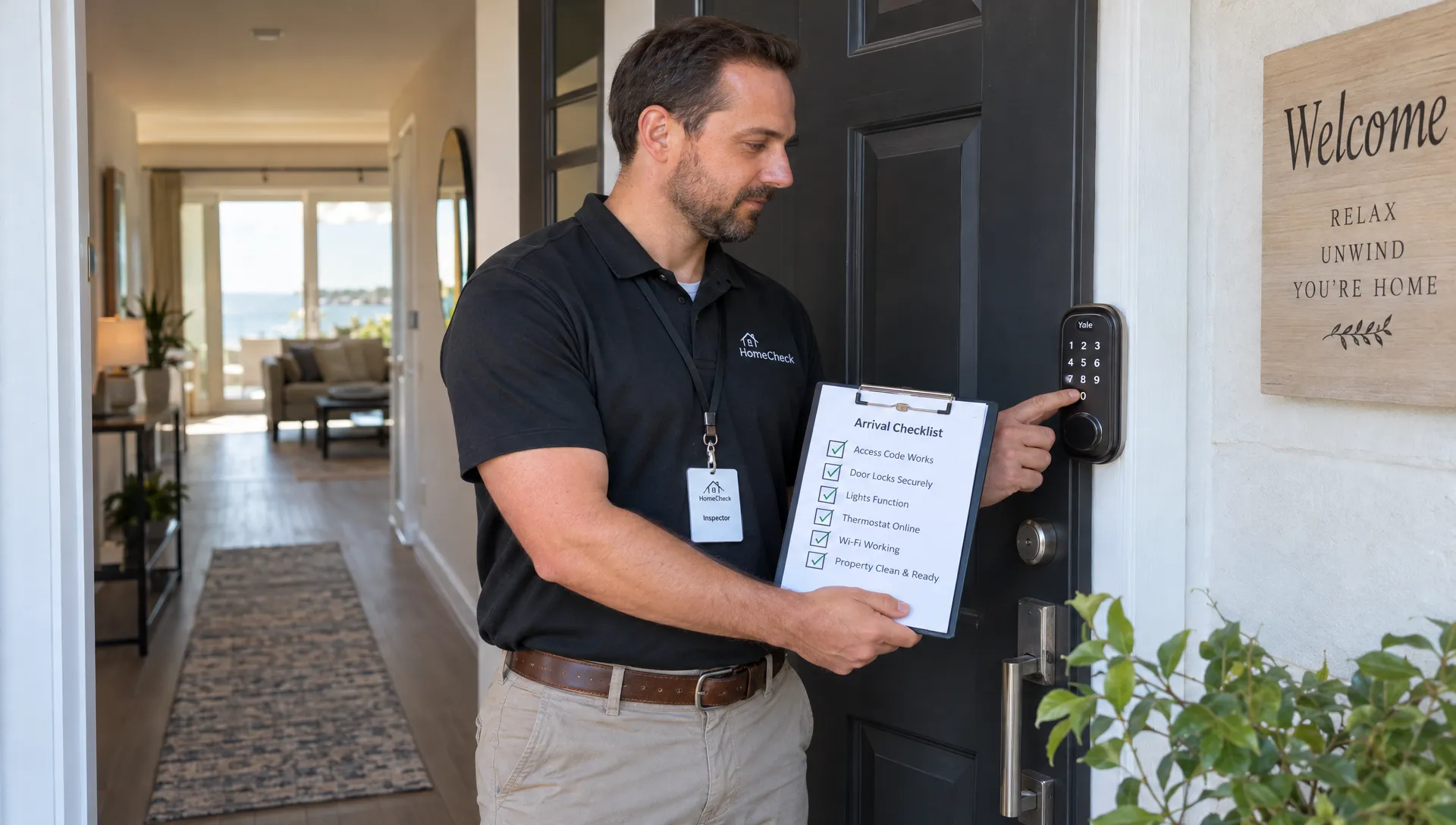
A turnover is a chain of handoffs, not one cleaning appointment. The departing guest leaves, the cleaner resets the home, someone checks readiness and the arriving guest receives accurate access instructions.
“Cleaning scheduled” is not the same as “property ready.” A cleaner can finish while a dryer remains broken or a patio door won't lock.
What proves a home is ready for check-in?
Ask for a property-specific checklist and exception reporting. Depending on the home, that can include bed setup, bathroom supplies, kitchen essentials, temperature, entry access, outdoor furniture and pool or hot tub condition.
Photos help document visible conditions, but they don't prove that an appliance works. Functional checks should match the home's equipment and risks. A technician, not an unqualified cleaner, should assess technical faults.
Our guide to rental management services that protect homes explains the safeguards behind that readiness standard. The daily question is whether those safeguards were completed for this arrival.
An illustrative Scottsdale turnover
Consider a hypothetical whole-home booking with an 11 a.m. checkout and a 4 p.m. arrival. During turnover, the cleaner notices a pool circulation problem.
The correct response isn't to mark the house ready and hope the guest doesn't notice. Someone must contact a qualified pool vendor, keep the amenity unavailable until it is cleared for use and tell the arriving guest what is known. Any remedy should follow the booking terms and applicable platform rules.
A short term rental agency should own that sequence, including the follow-up. The owner should receive a concise update and any decision requiring authorization, not a string of forwarded messages asking them to coordinate everyone.
This illustrates an operational lesson: a task isn't complete because someone acknowledged it. It's complete when the outcome has been verified.

Who handles guest questions and after-hours problems?
Guest communication includes pre-arrival instructions, access questions, equipment guidance, timing requests and complaints. It also includes noticing when a routine question signals a bigger problem.
“The house feels warm” might require thermostat instructions. It might also indicate an air-conditioning failure. The response process needs a route from message to diagnosis to local action.
At Lumina, we use Conduit AI for 24/7 guest messaging, with an average reply time under 10 minutes. That response metric is separate from repair time. A failed water heater doesn't become a ten-minute repair because the first reply was fast.
Who owns an after-hours problem?
Your short term rental agency should identify who handles urgent escalation, which local vendors can respond and what spending authority applies. Ask what happens when the first vendor doesn't answer.
Emergency guidance must also distinguish hospitality support from emergency services. A guest facing an immediate threat should contact the appropriate emergency service, not wait in a messaging queue.
For non-emergency issues, the operating record should show the report, actions taken, guest updates and final resolution. Automated acknowledgment without a responsible person or next step is not full-service support.
Should pricing and booking visibility be checked daily?
Yes, but reviewing prices daily doesn't mean changing them daily. The team should check new bookings, cancellations, approaching vacant dates and restrictions that could prevent a suitable reservation.
For a luxury home, a lower rate can increase occupancy while reducing owner income. Pool heating, additional turnovers and maintenance wear still cost money. We prefer evaluating the economics of a booking over celebrating a full calendar in isolation.
A short term rental agency should explain why it changed a rate or minimum stay. “The software recommended it” isn't enough. Our breakdown of dynamic pricing mistakes covers the cost assumptions and comparable-property errors worth checking.
Booking visibility needs attention too. Availability should agree across channels, listing details should reflect current conditions and eligible review requests should follow completed stays. A full photography refresh is periodic work; correcting a misleading amenity description shouldn't wait for a quarterly review.
A French-language guide to building year-round bookings beyond rental platforms uses Réunion as its example, connecting direct booking, local search, social media and guest reviews. The transferable point is channel diversity, not a promise that another destination's results apply to your home.
If you're unsure which responsibilities your current arrangement covers, ask Lumina for a property-specific management conversation alongside a free revenue estimate. Scope and assumptions should come before an income projection.
What compliance work belongs in the daily operation?
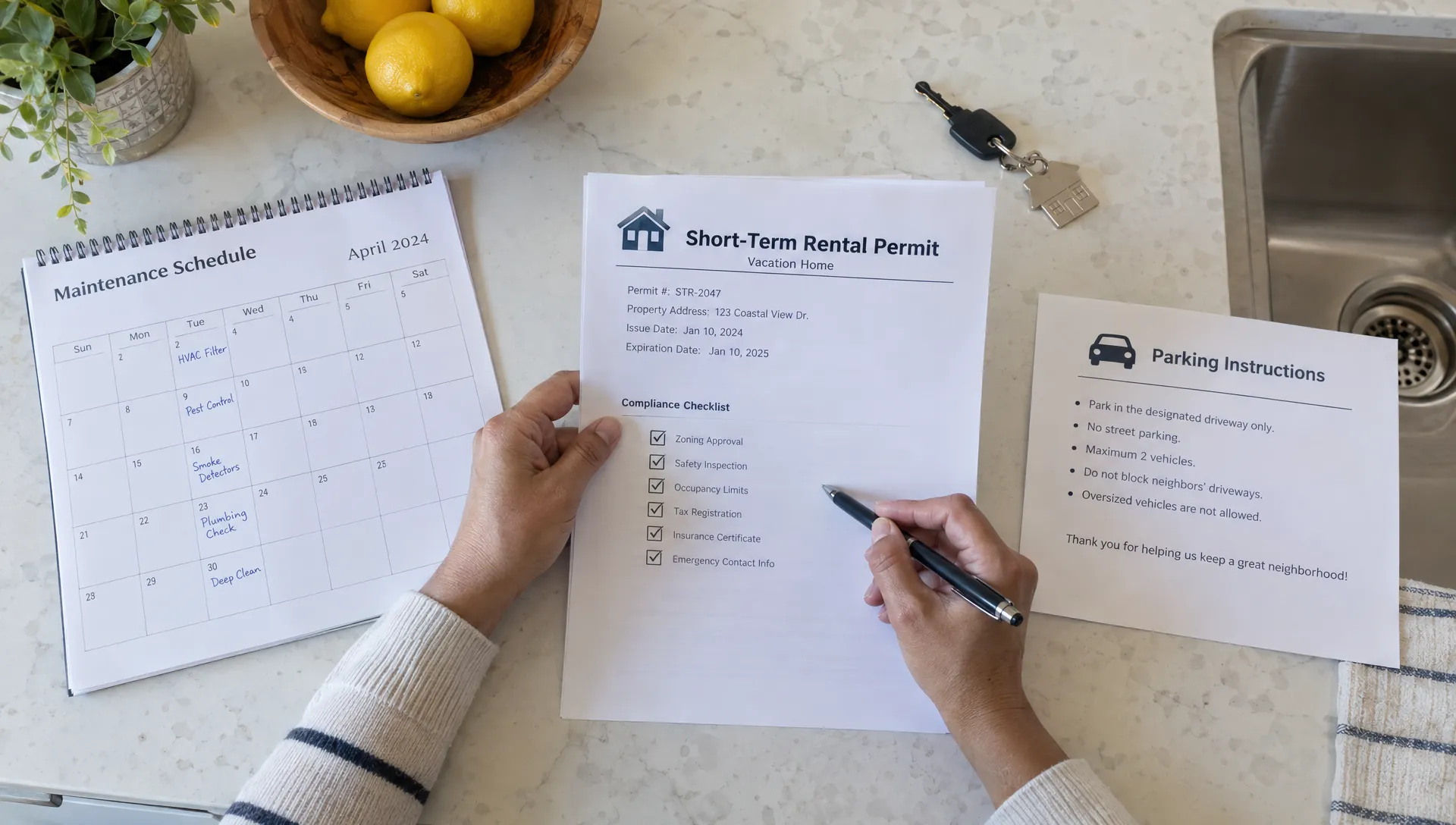
Permits, zoning and tax registration require property-specific verification before accepting reservations. An agency should also check HOA restrictions, recorded community rules, insurance requirements and lease restrictions where relevant. A city allowing rentals doesn't establish that your particular address qualifies.
The SBA's licensing and permitting guidance explains that requirements depend on business activity and location. For a rental, the agency should identify the relevant local authorities and document what has been checked. Obtain legal or tax advice when the answer requires it.
Daily management means following those established requirements: permitted occupancy, parking instructions, applicable stay-length restrictions and any required guest information. Renewals and filing deadlines belong on a tracked calendar rather than in someone's memory.
Your short term rental agency should distinguish its administrative responsibilities from yours. Who renews the permit? Who files which tax return? Which taxes does a platform collect, and what remains payable elsewhere?
Rules aren't necessarily re-researched every morning. They should be reviewed at onboarding, before material operating changes and when authorities issue updates. “We handle compliance” needs a written scope, not an assumption that all liability transfers to the manager.
What records should owners be able to inspect?
An owner shouldn't need daily involvement to understand the business. The agency should maintain records as work happens, then summarize performance on the agreed reporting schedule.
For maintenance, that means the issue, authorization, vendor, invoice and completion status. For bookings, it means accommodation revenue, discounts, refunds, channel charges and relevant adjustments. Owner-use dates and maintenance blocks should remain distinguishable from bookable vacancy.
A short term rental agency should be able to explain an exception without reconstructing it from scattered texts. A monthly statement is more useful when it connects to the underlying transactions.
Which numbers should owners be able to reconcile?
Start with booked nights, available nights, accommodation revenue, average nightly rate, management fees and operating expenses. Ask how each metric is calculated. Occupancy measured against all calendar nights tells a different story from occupancy measured only against nights offered for rent.
Performance claims also need comparable properties: similar location, bedroom count, amenities, condition and booking dates. A nearby apartment isn't a useful revenue benchmark for a private home with a pool.
Gross revenue alone cannot establish profitability. The owner needs a path from booking revenue to the amount received, with expenses and exclusions visible. Projected returns should state assumptions rather than disguise a best-case scenario as an expected result.
Which fees and contract terms affect daily service?
The fee percentage matters less without its calculation basis and service scope. Compare whether cleaning charges, pet fees, cancellation income or other receipts enter the management-fee calculation.
For illustration only, a 20% fee on $10,000 in accommodation revenue equals $2,000. If the same fee also applies to $1,000 in cleaning charges, it becomes $2,200. Those figures demonstrate fee math, not Lumina pricing.
Ask your short term rental agency which services cost extra, whether vendor invoices carry a markup and what repair spending requires approval. Include onboarding costs, photography, inspections and after-hours dispatch in that discussion.
Also establish owner access to listing information, reservation records and statements. Contracts should address termination notice, existing bookings, listing continuity and the return or transfer of access credentials. Platform rules may limit what can transfer.
Our guide to evaluating a rental management company provides a broader selection framework. For this daily-work audit, ask each candidate to walk through one turnover and one unresolved maintenance issue from start to finish. Their handoffs will tell you more than a list of software subscriptions.
Frequently asked questions
Does full-service management mean the owner never makes decisions? No. Owners still set financial boundaries, approve major work and make investment decisions. The manager should handle routine execution within agreed authority rather than seek approval for every minor task.
Should an agency inspect the home every day? Not necessarily. Inspections should follow turnovers, maintenance needs, vacancy risks and the agreed service plan. Daily oversight doesn't require unnecessary entry into an occupied home, and guest privacy and notice requirements still apply.
How can I check whether my short term rental agency is doing the work? Request a completed turnover record, an anonymized maintenance timeline, a sample owner statement and an explanation of the after-hours escalation process. Look for assigned responsibility and verified outcomes, not just activity counts.
Who pays for repairs and replacement supplies? The contract should specify owner-paid expenses, included consumables, reserve requirements and approval thresholds. Management coordination and the underlying repair bill are separate costs unless the agreement says otherwise.
Put the daily workload in writing
Before signing, ask the manager to document who handles arrivals, guest problems, vendor dispatch, rate reviews, compliance deadlines and reporting. Then ask what happens when the normal process fails. That is where the difference between listing assistance and full-service management becomes visible.
For a property-specific assessment, get a free revenue estimate or discuss listing your property with Lumina. Contact newhomes@staywithlumina.com or call (602) 905-7540. Ask us to explain the operating scope alongside the revenue assumptions.
I want owners to know what happens after the first guest message, not just how quickly someone replies. At Lumina, our work connects guest communication, cleaning coordination, maintenance dispatch and owner reporting because none of those functions succeeds in isolation.
— Shariann